
PART 1 - The Therapy-Speak Problem: When Psychological Language Stops Helping Us Understand Each Other

Author: Shifa Meherally

How "gaslighting," "narcissist," "trauma," "boundaries," and "toxic" became part of everyday vocabulary and why psychological literacy can quietly become psychological oversimplification.
We Have More Words for Our Feelings Than Ever. Do We Understand Them Better?
He's a narcissist.
She's gaslighting me.
That's my trauma response.
I'm protecting my peace.
You crossed my boundary.
They're emotionally unavailable.
That's toxic.
A decade ago, many of these phrases would have sounded distinctly clinical. Today, they show up in an argument between partners, a WhatsApp conversation between friends, a breakup message, an office discussion, or underneath a 30-second Instagram Reel.
Psychology has left the therapy room.
It lives on our feeds.
And that is not necessarily a bad thing.
There is something genuinely progressive about a culture becoming comfortable enough to discuss anxiety, attachment, trauma, emotional regulation, boundaries and mental health in ordinary conversation. Psychological language can give people names for experiences they previously could not articulate. It can help someone recognise an unhealthy pattern, seek support, communicate a need, or understand that their emotional experience deserves attention.
But there is a strange paradox emerging.
The discipline of psychology is built around context, assessment, probability, individual differences and uncertainty.
Social media is built around speed, recognition, certainty and compression.
One asks:
What is happening here, and what evidence do we have?
The other asks:
Does this sound like you?
And that difference matters.
A 2025 analysis of 10,395 Instagram posts from 294 psychotherapist influencers found that interpersonal concerns were the most frequently discussed mental-health topic, followed by anxiety, trauma/PTSD, depression and stress. The researchers also found that some psychotherapy topics attracted significantly more engagement than others.
Psychological information is no longer something people primarily encounter through therapists, textbooks, universities or mental-health services.
It is appearing between advertisements, dating advice, celebrity commentary and cooking videos.
And when psychological concepts enter popular culture, they inevitably change.
The question is not whether that change is good or bad.
The more interesting question is:
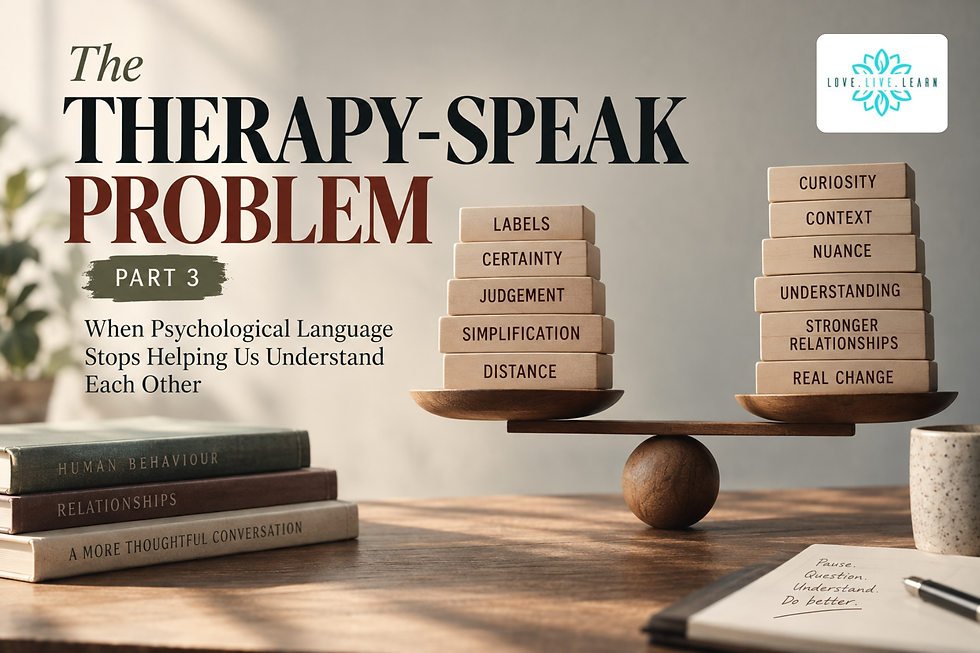
at what point does psychological language stop helping us understand human behaviour and start helping us categorise it?
The Paradox: Psychological Literacy Can Make Us More Informed and Less Curious
There is an understandable reason people love therapy-speak.
Labels can be validating.
Imagine spending years believing that you are simply too sensitive, only to discover the language of emotional invalidation.
Imagine thinking you are bad at relationships and encountering attachment theory for the first time.
Imagine believing you are selfish for saying no, and learning that boundaries are a legitimate part of healthy relationships.
Language can transform experience. It can take something vague and make it discussable.
But psychological terminology carries an unusual danger because it sounds authoritative.
Calling someone selfish is an opinion.
Calling someone narcissistic sounds psychological.
Calling a disagreement gaslighting sounds clinical.
Calling an emotional reaction a trauma response sounds explanatory.
The vocabulary can therefore create an illusion of expertise.
This is particularly relevant in the age of algorithmic mental-health education. A 2024 review of mental-health misinformation on social media concluded that misinformation is common, although its prevalence varies considerably by disorder and treatment area. The authors also noted an important distinction between genuinely false information and overgeneralisations derived from personal experiences, which can also become misleading when presented as universal psychological truths.
That distinction is crucial.
A creator saying,
"This happened to me, and this is how I understood it," is sharing an experience.
A creator saying,
"If someone does X, it means they have Y," is making a psychological claim.
The second requires considerably more evidence. Yet social media often rewards the second, because certainty is easier to consume than nuance.
Why We Turn Complex People Into Simple Labels
The Human Brain Likes Categories
Human cognition relies heavily on categorisation.
We categorise objects, people, events and experiences because categories reduce cognitive load. Instead of processing every individual feature of every person we encounter, we create mental shortcuts.
This is useful. Without categorisation, ordinary life would be cognitively exhausting.
But psychological labels introduce a particularly powerful form of categorisation, because they appear to explain why someone behaves the way they do.
Consider the difference:
"My partner repeatedly dismisses my concerns."
versus:
"My partner is a narcissist."
The first describes behaviour. The second creates an identity.
Once the identity is established, future behaviour can be interpreted through it.
Your partner disagrees with you?
Narcissistic.
They apologise?
Probably manipulation.
They become defensive?
Narcissistic injury.
They ask for space?
Emotional abuse.
The label becomes a lens through which contradictory information can be filtered.
This is where confirmation bias becomes relevant. Once we develop a hypothesis about someone, we tend to notice information that supports it more readily than information that challenges it.
Psychological language can therefore become self-reinforcing. The more we see through the label, the more evidence we seem to find for the label.
The Recognition Trap
Social-media psychology relies heavily on recognition.
Seven signs you have an anxious attachment style.
Five signs your mother is emotionally immature.
Ten signs you're dating a narcissist.
Six signs your nervous system is dysregulated.
The format is powerful because humans are extremely good at finding ourselves in descriptions.
You read: You overthink messages.
You think: That's me.
Then: You worry people will leave.
Definitely me.
Then: You need reassurance.
Oh my God, this is literally me.
The experience of recognition can feel diagnostic.
But recognition is not diagnosis.
A symptom or behaviour is rarely unique to one psychological construct. Overthinking can occur with anxiety, stress, uncertainty, perfectionism, relationship insecurity, sleep deprivation, situational distress, or simply an important decision.
Difficulty concentrating can occur in ADHD. It can also occur when someone is exhausted. Or grieving. Or anxious. Or bored. Or chronically stressed.
Psychological assessment exists partly because the same observable behaviour can have multiple explanations.
A 30-second video usually cannot make those distinctions.
So we're left with a strange contradiction: the language that was supposed to make us more emotionally literate might also be teaching us to reach for a diagnosis before we've even finished describing what happened.
That raises an obvious next question - is this just a vague cultural drift, or has it actually reshaped what specific words like narcissist, gaslighting, trauma and boundaries mean in practice?
Next up in Part 2: we take those four words one at a time - where they came from clinically, what they've come to mean online, and why the gap between the two is bigger than most people realise.

Comments