
PART 2 - The Therapy-Speak Problem: What Happens When Clinical Words Go Viral

Author: Shifa Meherally

In Part 1, we looked at why our brains reach for psychological labels so quickly - the recognition trap, the illusion of expertise, the way a label can feel like a diagnosis when it's really just a guess dressed up in clinical language.
That raises the obvious next question: has this actually changed what specific words mean? Let's take four of the most commonly used ones: narcissist, gaslighting, trauma, and boundaries, and look at where they came from, and where they've ended up.
Narcissist: From Personality Construct to Relationship Insult
Few psychological words have travelled further from their clinical origins than narcissist.
Online, it can mean:
selfish
arrogant
manipulative
emotionally unavailable
vain
self-obsessed
difficult
controlling
or simply someone who hurt us
But narcissism is not synonymous with being unpleasant.
Psychology distinguishes between narcissistic traits and Narcissistic Personality Disorder as a diagnosable personality disorder involving a pervasive pattern of grandiosity, need for admiration and impaired empathy, alongside other diagnostic requirements.
And the distinction matters.
A person can behave selfishly without having NPD. A person can be arrogant without having NPD. A person can behave cruelly in one relationship without having a personality disorder.
Conversely, someone with significant narcissistic pathology will not necessarily resemble the exaggerated internet stereotype in every interaction.
A 2026 Journal of Personality study examining how laypeople conceptualise narcissism found that public understandings of narcissism overlap with, but are not identical to, established psychological measures of narcissism. In other words, ordinary people have developed their own working definition of "narcissism" and that definition does not perfectly map onto the construct used in psychological research.
This is exactly the problem with psychological vocabulary becoming popular without its conceptual boundaries.
The word survives. The construct changes.
Gaslighting: When Disagreement Becomes Abuse
Gaslighting is another example.
The term originates from Patrick Hamilton's 1938 play Gas Light and its subsequent film adaptations, in which a husband systematically manipulates his wife into questioning her perception of reality.
Its psychological significance lies in the pattern. The goal or effect is not merely to disagree. It involves undermining another person's confidence in their own perceptions, memories or judgement within a relational or power context.
But online, gaslighting has increasingly become shorthand for almost any experience of invalidation.
Someone says they don't remember it that way - you're gaslighting me. Someone gives feedback - you're gaslighting me. Someone disagrees - you're gaslighting me. Someone makes a mistake - you're gaslighting me.
This is not simply a semantic problem.
A 2025 interdisciplinary review of gaslighting literature found significant inconsistencies in how gaslighting has been conceptualised across medicine, psychiatry, psychology, sociology and philosophy. The authors argue that greater conceptual clarity is needed for research, policy and practice.
If researchers themselves are still working through definitional complexity, it is worth being cautious about declaring a relationship "gaslighting" because someone disagreed with our recollection of an event.
This does not mean gaslighting is not real. It means real phenomena deserve precise language.
Trauma: When Suffering Becomes a Psychological Identity
Perhaps the most important example is the word trauma.
Trauma has become extraordinarily common in everyday speech. People describe embarrassing experiences as traumatic, difficult breakups as trauma, strict parenting as trauma, awkward social situations as trauma, ordinary workplace stress as trauma.
Again, context matters. Some experiences that appear ordinary from the outside can be profoundly traumatic depending on circumstances, meaning and exposure. Psychological trauma is not simply determined by whether an event sounds "bad enough" to someone else.
But there is an increasing tendency to use trauma as a universal explanation for distress.
Research supports this observation. A 2025 study analysing 143 TikTok videos tagged #trauma found that trauma was frequently attributed to childhood adversity and relationship difficulties, while a wide range of behaviours and experiences were presented as evidence of trauma. The researchers interpreted these findings as consistent with the broader phenomenon of "concept creep," in which concepts relating to harm expand to encompass a broader range of experiences over time.
Concept creep is fascinating because it contains a genuine tension. Broadening a concept can make previously invisible forms of suffering visible. But excessive expansion can also make the concept less discriminating.
If everything painful is trauma, the word eventually tells us less about the nature of the experience.
That is not validation. It is dilution.
Boundaries: The Difference Between a Limit and a Demand
Then there is perhaps the most positively associated word in modern therapy-speak: boundaries.
And boundaries are important. Very important.
But social-media discourse sometimes transforms boundaries from statements about our own participation into demands about other people's behaviour.
Consider:
"If you continue insulting me, I will leave the conversation."
That is a boundary. It identifies behaviour, identifies what the individual will do, and preserves the other person's autonomy.
Compare it with:
"My boundary is that you cannot disagree with me."
That is not really a boundary. It is a demand for control.
The distinction matters because healthy relationships require mutual negotiation, not permanent emotional insulation.
A 2026 systematic review of therapeutic boundary negotiation found that even within psychotherapy, boundaries are not simply rigid rules. They involve an ongoing balance between structure and flexibility, self-regulation, context, ethical judgement and relational processes.
If boundaries require this much contextual thinking inside therapy itself, it is worth being cautious about turning them into rigid social-media slogans.
A boundary is not: "You must never make me uncomfortable."
It is closer to:
"I get to decide what I participate in."
That distinction can completely change the quality of a relationship.
The Environment Rewards Misunderstanding
There is an important structural issue underneath all four of these examples.
The problem is not simply that people misunderstand psychology. It is that the environment in which psychology is being consumed rewards misunderstanding.
A nuanced psychological explanation might require: It depends. There are several possible explanations. This cannot be determined without assessment. The research is mixed. This construct should not be confused with a diagnosis.
These are scientifically responsible statements. They are also terrible Instagram hooks.
Compare them with: "If they do these 5 things, RUN."
The second is emotionally immediate. It creates recognition. It creates urgency. And it creates engagement.
The 2025 Instatherapy study found that different psychotherapy topics generated different levels of user engagement, demonstrating that the social-media environment is not neutral in what it rewards. This doesn't mean therapists are deliberately spreading misinformation. Another 2025 study interviewing psychologists who use Instagram highlighted the tension professionals experience between public education, professional identity, accessibility and the limits of communicating psychological knowledge through social media.
The problem is partly structural: nuance does not travel as efficiently as certainty.
When Recognition Turns Into Self-Diagnosis
This becomes more consequential when people begin using social media not merely to learn about psychology, but to diagnose themselves.
A 2025 pilot study of 57 young people entering treatment for mood and anxiety disorders found that all participants had previously consumed mental-health content online. Most reported believing they had diagnoses that had not previously been given by a clinician, and most of those participants indicated that social media had contributed to that belief. Greater mental-health content consumption was associated with self-diagnosis, and YouTube use was particularly associated with it in this sample.
The finding does not mean self-recognition is inherently bad. In fact, self-recognition can be the beginning of appropriate help-seeking. Someone may read about obsessive-compulsive symptoms and realise: wait, this describes something I've been experiencing. That can be enormously useful.
The problem comes when "this sounds familiar" becomes "therefore, I have this disorder."
Diagnosis is not simply symptom matching. Clinical diagnosis involves differential assessment, duration, impairment, context, developmental history and ruling out alternative explanations.
The distinction becomes even more important when the label becomes part of identity. A 2025 qualitative study of college students found that students frequently encountered diagnostic content on social media and distinguished between privately identifying with a condition and publicly claiming a diagnosis. They also expressed concerns about misinformation and the legitimacy of self-diagnosis, while recognising that self-identification can be particularly relevant when professional care is inaccessible.
That is the nuance worth preserving.
Self-recognition can be a doorway to care. It should not become a substitute for assessment.
So we've gone from a general pattern to four specific words, and the same story keeps repeating: a clinical term with a precise, bounded meaning gets picked up by a culture that rewards certainty over nuance, and comes out the other side doing a very different job than the one it was built for.
That's not a small cost. If every difficult person is a narcissist and every disagreement is gaslighting, we start losing our ability to tell the difference between things that are actually different.
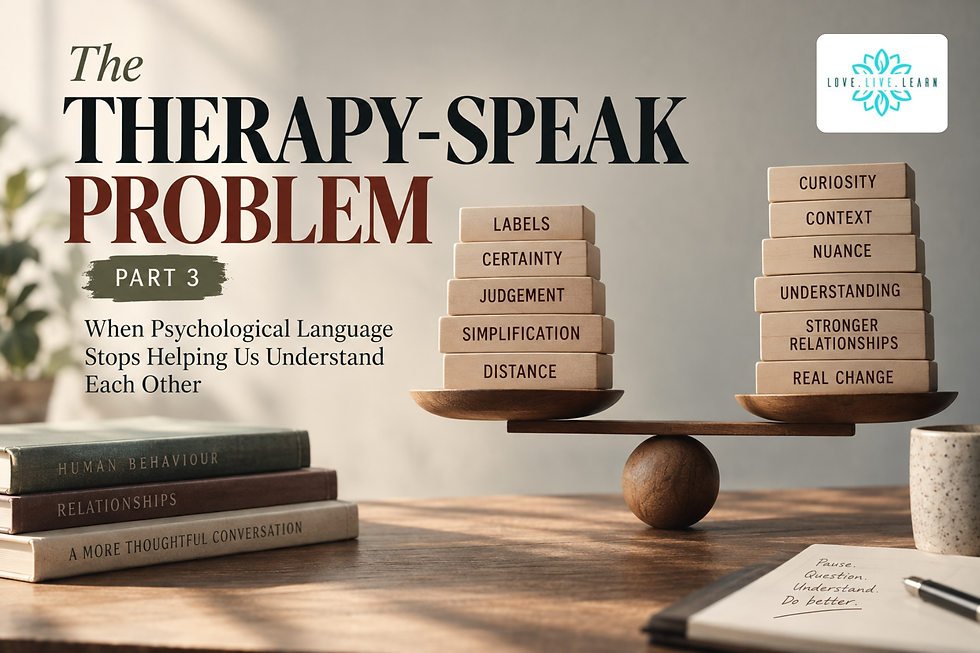
Next up in Part 3: why that loss of precision matters more than it seems, the danger of overcorrecting in the opposite direction, and the practical tools that actually help you use this language without losing the plot.

Comments