
Part 3 - The Therapy-Speak Problem: When Psychological Language Stops Helping Us Understand Each Other

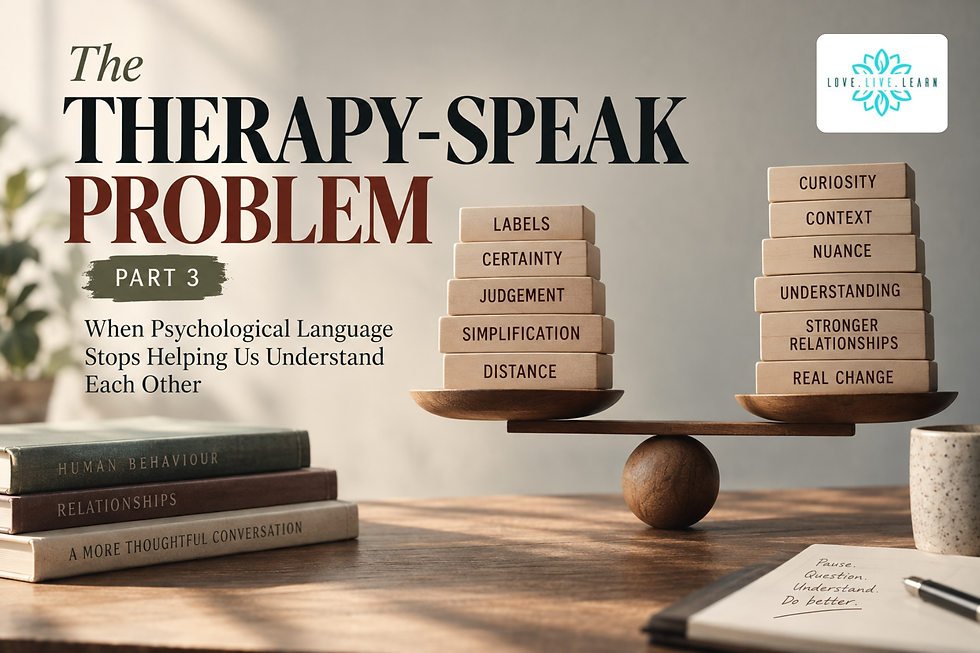
In Part 2, we walked through four words - narcissist, gaslighting, trauma, boundaries - and watched the same pattern repeat each time: a precise clinical term gets picked up by a culture that rewards certainty over nuance, and comes out the other side doing a very different job.
That's not just a linguistic curiosity. It has real consequences for how we see each other and ourselves.
Why It Matters
Language does not merely describe reality. It helps construct the way we perceive reality.
If every difficult person is a narcissist, we lose the distinction between arrogance and personality pathology.
If every disagreement is gaslighting, we lose the distinction between disagreement and psychological manipulation.
If every difficult experience is trauma, we lose conceptual precision around trauma.
If every interpersonal discomfort is a boundary violation, we may lose tolerance for negotiation.
And if every emotional reaction is a "nervous-system response," we may begin treating ordinary emotional experiences as evidence that something is fundamentally wrong.
There is another danger:
pathologizing ordinary human behaviour can make relationships more brittle.
Human relationships involve frustration. Misunderstandings. Jealousy. Conflict. Repair. Compromise. Disappointment. Differences in needs.
Sometimes people hurt each other without being abusive. Sometimes people are selfish without being narcissistic. Sometimes people make mistakes without manipulating us. Sometimes we are the ones who are wrong.
Psychological maturity must include the capacity to tolerate that possibility.
Otherwise, therapy-speak becomes a sophisticated vocabulary for externalising responsibility.
But We Should Be Careful Not to Swing Too Far
There is a danger in criticising therapy-speak too aggressively.
If we say "everyone is overusing the word trauma," someone who genuinely experienced trauma may hear: your experience isn't real.
If we say "stop calling people narcissists," we must not imply that emotionally abusive relationships do not exist.
If we criticise the language of boundaries, we should not accidentally return to a culture in which people are expected to tolerate mistreatment.
That would be another form of oversimplification.
The answer is not: stop using psychological language.
It is:
use psychological language with psychological precision.
That means knowing the difference between:
a feeling and a diagnosis
a trait and a disorder
a behaviour and a personality
a hypothesis and a conclusion
a boundary and a demand
a difficult experience and a traumatic exposure
validation and confirmation
That final distinction may be the most important.
Validation means: your experience makes sense, and I can understand why this affected you.
Confirmation says: your interpretation is definitely correct.
A therapist can validate your distress without automatically validating your explanation for it. We should be able to do the same for ourselves.
What Research Suggests Can Help
1. Describe Before You Diagnose
Instead of: "My partner is narcissistic."
Try: "When I raise a concern, my partner frequently redirects the conversation toward themselves and becomes hostile when criticised."
The second statement is longer. It is also infinitely more useful. Behaviour can be observed. Labels require interpretation.
2. Turn Labels Into Questions
Instead of "I'm anxiously attached," ask: what happens to me when I experience uncertainty in close relationships?
Instead of "my mother is toxic," ask: what specific patterns in this relationship are harmful to me?
Instead of "I'm traumatised," ask: what happens emotionally, cognitively and physically when I encounter reminders of this experience?
Questions preserve curiosity.
3. Use CBT-Style Reality Testing
When you encounter a psychologically charged claim, separate: Event → Interpretation → Emotion → Behaviour
For example:
Event: My partner did not reply for six hours.
Interpretation: They don't care about me.
Emotion: Anxiety.
Behaviour: I send five messages and then accuse them of being avoidant.
Now ask: what else could explain the event?
That does not mean dismissing your feelings. It means distinguishing the feeling from the story attached to it.
4. Use ACT Defusion
Instead of "I am a people-pleaser," try: "I'm noticing a pattern of avoiding conflict by prioritising other people's needs."
Instead of "my partner is toxic," try: "I'm noticing behaviours in this relationship that are harmful to me."
The shift from identity to observation creates psychological flexibility. You are no longer trapped inside the label.
5. Practise Epistemic Humility
Use words such as: I wonder... It seems... I might be interpreting... One possibility is... I'm not sure yet.
This may sound less powerful than declaring "this is exactly what is happening."
But uncertainty is not intellectual weakness. It is what intellectual honesty sounds like when evidence is incomplete.
6. Ask Whether the Label Helps You Act
A surprisingly useful question is: what does this label help me do?
If calling someone narcissistic helps you recognise a pattern and seek safety, it may have practical value. If it simply helps you win an argument, it may not.
If calling something a boundary helps you communicate a limit, useful. If it is being used to prevent another person from having a different opinion, reconsider.
If calling something trauma helps you seek appropriate care, useful. If it becomes an explanation for every reaction you have, investigate further.
A psychological concept should ideally increase agency, not simply increase certainty.
Helpful Resources
Books
The Happiness Trap - Russ Harris
A strong introduction to Acceptance and Commitment Therapy and psychological flexibility.
Self-Compassion - Kristin Neff
Useful for understanding how self-compassion differs from self-indulgence and self-criticism.
Attached - Amir Levine & Rachel Heller
Accessible introduction to attachment concepts, best treated as an introduction rather than a diagnostic tool.
Atomic Habits - James Clear
Helpful when the focus shifts from understanding behaviour to actually changing it.
Podcasts
Speaking of Psychology (American Psychological Association)
Hidden Brain
The Happiness Lab
They are useful because they tend to explore psychological ideas with more context than short-form social media permits.
Exercises
The Behaviour, Meaning, Label Exercise
Write down a recent interpersonal conflict. Then make three columns: what happened, what I interpreted, what I called it.
For example: they interrupted me repeatedly → they don't respect me → toxic. Or: they denied remembering an event → they're making me doubt myself → gaslighting. Or: they needed space → they're emotionally unavailable →
avoidant.
Now ask: what would I know if I removed the label?
This exercise does not tell you that your interpretation is wrong. It simply separates observation from inference.
The Psychological Vocabulary Audit
For one week, notice every time you use one of these words: toxic, narcissist, gaslighting, trauma, triggered, boundary, emotionally unavailable, attachment, dysregulated.
Then ask: What did I actually observe? What did I mean by the term? Do I know that the term is technically accurate? Is the label helping me communicate? What would I say if psychological terminology did not exist?
That final question is surprisingly revealing.
Reflection Questions
Before calling yourself, your partner, your parent, your colleague or your friend something psychologically loaded, pause. Ask:
What exactly happened?
What am I feeling about what happened?
What meaning have I assigned to it?
Am I describing behaviour or diagnosing a person?
What evidence supports my interpretation? What evidence might complicate it?
Could there be another explanation?
Is this label helping me understand, or helping me judge?
Am I using a boundary to protect myself or to control someone else?
Have I confused validation of my feelings with confirmation of my interpretation?
What would change if I remained curious for five minutes longer?
If a psychologist heard only my version of this story, what information would they still need before drawing conclusions?
Closing Thought
Perhaps the greatest achievement of modern mental-health culture is that people finally have words for experiences they were once forced to suffer through silently.
That is worth protecting.
But psychological language was never designed to turn human beings into neat categories. It was designed to help us understand complexity.
And complexity is inconvenient. It does not fit neatly into a carousel. It cannot always be reduced to five signs. It does not always produce a villain and a victim.
Sometimes you are hurt and still partly responsible. Sometimes another person behaves badly without having a disorder. Sometimes two people remember the same event differently. Sometimes a boundary is necessary. Sometimes compromise is necessary. Sometimes you are genuinely traumatised. Sometimes you are simply having an extraordinarily difficult week.
And sometimes the most psychologically sophisticated answer is:
"I don't know yet."
That sentence can feel unsatisfying in a culture addicted to psychological certainty. But perhaps that is exactly why it matters.
Because the purpose of psychological language should not be to help us become better at labelling people.
It should help us become better at understanding people. Including ourselves.
And if the language that was supposed to make us more self-aware eventually makes us less curious, less accountable and less capable of seeing another person's complexity, then perhaps we have not become more psychologically literate.
We have simply learned how to sound psychological.


Comments